
December 2018
Our Changing Wildlife
The speaker at the Centre’s December meeting was Brett Westwood. Brett was formerly with the BBC Natural History Unit and is an advisor to the ‘Spring Watch’ TV programme. He sometimes appears on the ’Today’ Radio 4 programme. Brett is a local naturalist and is the author of a number of books.
Brett’s lively and entertaining presentation brightened up a gloomy December afternoon. His talk focused on the effects of climate change on nature. The effects are not all bad and a number of species have benefited.
The Speckled Wood butterfly now has two broods annually, and the Red Admiral butterfly now thrives through the milder winters. The Scarlet Tiger moth is doing well and spreading north. The number of crickets are growing rapidly, as are hover flies. There are at least 240 different types of bees in this country and 25 different bumble bees. The sandstone areas of Kinver Edge and Hartlebury Common have large numbers of solitary bees.
Girdled snails, Lily beetles and Rosemary beetles from France and the Mediterranean have spread to this country from imported plants sold from garden centres. Daddy Long Legs spiders have spread when furniture is moved to properties by removal vans.
The tiny Horseshoe ladybird, just 1.25mm across, which feeds on whitefly is also from the Mediterranean. It is one of the rarest species of ladybirds in this country. It can be found at 5 sites in Kidderminster and 4 sites in Stourbridge. The Green-leaved spider, which lives in Ivy, can be found in the Severn Valley. There is an important colony of Pearl-bordered Fritillary butterflies in the Wyre Forest.
Ring-necked parakeets come from the foothills of the Himalayas, and were introduced into this country. There are now about 15.000 in the London area. A colony was established in West Park, Wolverhampton, from where they are spreading to our area. Mandarin ducks from Japan have also become well established.
Himalayan Balsam is now widespread. Whilst it is invasive, can cause erosion of river banks, excludes other plants and is fast growing, it is an important source of nectar for bees. Ragwort is the same. Poppies have become part of the British countryside, but this is also an introduced species – perhaps by the Romans.
November 2018
Thomas Chippendale – Celebrating 300 Years of a Master Cabinet Maker
The speaker at the Centre’s November meeting, held at Blakedown Parish Rooms, was Gareth Williams, who was making a return visit. He is Curator and Head of Learning at Weston Park, and used to work for Sotheby’s as a furniture expert. For a time he was employed by the National Trust at Nostell Priory in West Yorkshire.
Thomas Chippendale is the byword for excellence. He was born in Otley in Yorkshire, and was educated at King Henry Grammar School in the town. The year of his birth was 1718, and so his 300th anniversary was celebrated in 2018. He was apprenticed to his father, and his skills and craftsmanship developed. He was in the same world as Capability Brown and both did work for the earl of Coventry at Croome Court.
Chippendale realised his future was in London, and he moved there in 1748, the year that he married. He set up in Covent Garden, moved to the Strand, and then to St Martin’s Lane, where the business operated from 1753 until 1813 when his son, who had taken over, went bankrupt.
During the growth of his business, Chippendale undertook twenty-six commissions to furnish country houses. Not only did he supply furniture, but also carpets, wallpaper and mirrors. He published his definitive book of designs which sold out. A second edition followed in 1755, and a completely new edition was published in 1762. A French translation also appeared. Chippendale’s business continued to grow, and at least twenty other craftsmen worked for him.
Chippendale was given a significant commission by the earl of Dumfries to produce furniture for Dumfries House in Ayrshire during the period 1759-65. This extensive collection was saved by the Prince of Wales in 2007. A large collection of documentation has also survived.
The best representative collections of Chippendale furniture can be found at Dumfries House, Harewood House, and Nostell Priory. Gareth Williams illustrated his presentation with some fine examples of Chippendale’s work at these properties. Further examples of Chippendale’s skills can be found at Burton Constable Hall in Yorkshire, Paxton House near Edinburgh (where in the 1770s changing taste can be seen in the neoclassical designs), and Weston Park.
Thomas Chippendale retired in 1776, and his son took over the business. He had been hugely influential with his outstanding, elegant designs. The quality of his work is impressive. Fortunately, there are still skilled cabinet makers around today, carrying on the traditions.
October 2018
The speaker at the Centre’s October meeting, held at Trinity Methodist Church, Kidderminster, was Simon Trapnell. He is the Director of Nature in Art, a gallery for pictures and sculptures at Wallsworth Hall, near Gloucester, which dates from 1753. The museum was opened in 1988, realising his dream to establish a collection of works of art, inspired by nature.
Simon Trapnell’s talk showed some items from the large collection, which has works of art from well over 600 artists from 70 countries. Artists featured included Sir Peter Scott, Keith Shackleton and David Shepherd.
The extensive collection is well worth a visit. In fact, members of the Centre have been there on a coach outing. Mr Trapnell’s talk should have inspired his audience to view the collection for themselves or make return visits.
September 2018
The Ceramics of Ironbridge Gorge
The Centre’s new season of indoor meetings began at Trinity Methodist Church, Kidderminster with a talk by Kate Cadman. She is the Ceramics Curator at Ironbridge Gorge, where she has worked since 1982. Kate is responsible for Coalport China Museum, Jackfield Tile Museum and Broseley Clay Tobacco Pipe Museum.
The ceramics industry at Ironbridge Gorge employed some 1000 people, covering a range of products. It was a bigger industry than iron.
The decorative tile industry prospered. Craven Dunhill was established in 1874 and Maw & Co. (which became the largest tile works in the world) started in 1883. Glazed tiles were easily cleaned and were widely used in hospitals and public houses. The Arts and Crafts movement was a big influence in designs.
The Coalport China factory was founded by John Rose in 1796. High quality creamware was produced, employing up to 300 workers, many under the age of 20. It was a labour intensive industry with the piecework system of payment in place. Coalport China moved to Stoke in 1926.
Kate Cadman encouraged her audience to visit the Ironbridge Gorge, now a World Heritage Site. That small area has played an important role in this country’s industrial and social history. The famous Iron Bridge is being restored and re-painted red-brown. The work should be completed by the end of 2018.
May 2018
Beneath the dark Canopies 14th May 2018
The speaker at the centre’s May meeting held at Hagley Community Centre, was Dr. Michael Leach. Dr. Leach has addressed our members on previous occasions, and is a popular and entertaining speaker. He is the author of 32 books and has filmed 150 television programmes. He lectures extensively, and has just returned from giving a series of talks in China. So far this year he has spoken in 14 different countries.
Michael Leach is a full time zoologist and wildlife photographer. He started his career as a cameraman at the BBC. He said it can take up to a year to produce a 28 minute programme, and time and patience are needed. He has studied and worked with a wide range of animals, including owls, deer, badgers, hares, gorillas and orang-utans.
On this occasion, he focussed on rain forests, which cover just 4½% of the world’s area, but contain 52% of the world’s terrestrial wild life. Rainforests are most unpleasant places to experience, with high humidity and amazing levels of rainfall. There are many perils in rainforests including soldier ants, vampire bats and mosquitoes. (Dr. Leach has had malaria for 22 years). Temperatures can reach 45 degrees centigrade. It is difficult for light to penetrate the rainforest and many birds, plants and animals live high up in the canopy, about 130 feet above the ground.
Rainforests are so important for levels of oxygen. The loss of such areas, for timber and the production of palm oil, has a significant impact. The scale of the destruction is a matter of major concern – and continues. There about 600 uncontacted tribes in the Amazon rainforest but they are under enormous pressure. Gorillas in Africa attract tourists and so the local economy benefits, but the loss of habitat carries on. In Borneo, orang-utans, which share up to 99% of human DNA, are threatened with extinction as the relentless destruction of the rainforest goes on.
In the Amazon rainforest, where it can rain for days on end, it is a place of contrasts. Hummingbirds the size of a baked bean and long nosed bats, the size of a thimble, can be found. On the other hand, Dr. Leach has encountered flying foxes (bats with a wing span of 5 feet) and giant Brazilian sea otters (7½ feet long). Vampire bats can cause rabies and there are many risks of disease.
Michael clearly conveyed to his audience the dangers of the Amazon rainforest, and the worrying threat to the highly intelligent orang-utans in Borneo. His talk was illustrated with outstanding images of the wild life. He disclosed that he had eaten roasted tarantula – which tasted like scrambled eggs.
Chris Fonteyn (Chairman)
April 2018
Norman Wilkinson – A dazzling artistic career.
The speaker at the centre’s April meeting, held at Hagley Community Centre, was Dr. James Taylor. Dr. Taylor has spoken to the group on several occasions, and is a former curator of paintings at the National Maritime Museum at Greenwich. The subject of his talk on this occasion was Norman Wilkinson (1878-1971), and the implementation of his dazzle camouflage scheme.
Norman Wilkinson was a lieutenant commander in the Royal Naval Reserves. He was a traditional artist, in quasi impressionist style, who specialised in maritime art. He was a regular exhibitionist at the Royal Academy of Arts, and was also a poster designer.
During World War 1, British ships were under constant attack from German submarines, resulting in heavy losses. To help counteract this, Wilkinson’s dazzle camouflage scheme aimed to produce “An effect (By paint) in such a way that all accepted forms of a ship are broken up by a mass of strongly contrasted colour, consequently making it at a matter of difficulty to a submarine to decide on the exact course of the vessel to be attacked.” Wilkinson and his team designed the colourful abstract patterns that were then painted onto small ship models and then tested by reviewing them from all angles on a rotating table against a background simulating different weather conditions. The successful designs were transferred onto ship plans and sent to ports to be applied to the ships. Each dazzle scheme was unique with a different design for either side of the ship.
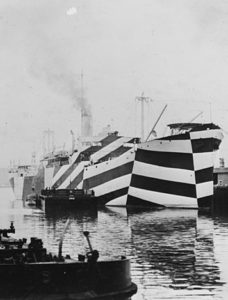
Wilkinson and his team carried out this work at the Royal Academy. Many were leading artists of their time, and Dr. Taylor illustrated his talk with fine examples of their work. The outstanding quality of the paintings selected impressed the audience.
There is no clear evidence t that dazzle camouflage was effective, but it did boost moral. During World War 2, dazzle camouflage was applied to aircraft. Later it could be seen in fashion design. In recognition of Norman Wilkinson’s work, he was awarded the OBE in 1918 and the CBE in 1948.
January 2018
Mary, Queen of Scots – the Captive Queen in England 1568-1587
The speaker at the Centre’s January meeting, held at Blakedown Parish Rooms, was David Templeman. This was his third visit to the group. He is a retired businessman with a particular interest in Elizabethan history. He is the chairman of the Friends of Sheffield Manor Lodge, one of the places where Mary, Queen of Scots was imprisoned. David Starkey is patron of the Friends.
David Templeman has worked on his recently-published book for twelve years which details the nineteen years of the captivity in England of Mary, Queen of Scots. Her captive years contained intrigue, escape attempts and plots to put her on the English throne. She was detained by her cousin, Queen Elizabeth I. Both were strong-willed women, Elizabeth being ten years older. Mary enjoyed hunting, riding and sport – she played golf at St Andrews.
After civil war in Scotland, Mary escaped to England to seek help from Elizabeth. She landed near Workington on 16 May 1568, and was given shelter by the Curwen family at Workington Hall. The following day she moved to Cockermouth Hall, the home of Henry Fletcher, a merchant banker. On 18 May, Mary was escorted to Carlisle Castle by Sir Richard Lowther, Deputy Governor of the castle and High Sheriff of Cumberland. That was to be the end of her freedom and the start of her confinement.
Mary was confined to several places, following Carlisle Castle, and the sequence is Bolton Castle (north Yorkshire), Tutbury Castle (Staffordshire), Wingfield Manor (Derbyshire), Chatsworth (Derbyshire), Sheffield Castle, Sheffield Manor Lodge, Buxton Old Hall, Worksop Manor, Chartley Manor (Staffordshire), and Fotheringhay Castle (Northamptonshire) where she was executed on 8 February 1587.
Chatsworth was used on seven occasions from 1573 to 1584. The sixth earl of Shrewsbury and his wife, Bess of Hardwick, were Mary’s principal custodians, for almost fifteen years.
David Templeman’s book carefully details Mary’s years of captivity as she was moved around the country, with many twists and turns. There were fears that Mary was the focus of plots to put her on the English throne, and both monarchs were manipulated by those around them.
After the Babington Plot, Mary was tried and found guilty of high treason. She died a Catholic martyr and was entombed at Peterborough Cathedral. Subsequently, in 1612 her son, James, moved her body to Westminster Abbey.
December 2017
The History and Restoration of an Eighteenth Century Playground: Painswick Rococo Gardens
The speaker at the Centre’s December meeting, held at Blakedown Parish Rooms, was Dominic Hamilton. He used to work for the National Trust at Snowshill Manor and then Tyntesfield. He moved to Painswick Rococo Gardens over two years ago.
A prominent city lawyer, Benjamin Hyett, wanted a country retreat and acquired land at Painswick in Gloucestershire. He built a house around a farmhouse there. On his death, his son Charles inherited the property, and commissioned a design which was geometrical, based on the style of gardens seen on Grand Tours of the Continent. The design of the Painswick garden is in the Rococo style, which is a period which only lasted twenty to thirty years, and is based on a painting dating from 1748.
In 1955 Lord Dickinson inherited the estate from his aunt. In the 1980s the restoration work began, and the garden was first opened to the public in 1988. Painswick is one of the few surviving examples of a Rococo garden. The house was sold by Lord Dickinson, and the family live elsewhere on the estate. The garden is in the care of a charitable trust.
Dominic Hamilton showed how the restoration work is progressing. The ongoing work is transforming the garden. A new head gardener has recently been appointed, who previously worked at the NT property, Upton House. Painswick Rococo Gardens is the venue for weddings, which are growing in number. A very productive kitchen garden grows produce for the popular café.
Effective publicity is attracting more visitors. When Dominic Hamilton started work there, the gardens attracted 26,500 visitors. Last year that figure had increased to 28,000, and by December 2017 there had been 37,000 visitors. Obviously, this brings in more income to fund the restoration project. Dominic has a growing team of volunteers to assist him.
Dominic encouraged his audience to visit Painswick Rococo Gardens. Each February up to 5 million snowdrops come into flower there, a magnificent sight. It is hoped to create a vineyard in the gardens. Meanwhile the restoration continues.
November 2017
The Vanity of Small Differences – The Story of the Grayson Perry Tapestries Explained
The speaker at the Centre’s November meeting, held at Blakedown Parish Rooms, was Amy Forster-Smith. She is the Visitor & Experience Manager at Croome Court, where she has worked for eleven years. She is in charge of exhibitions there, and recently the Grayson Perry tapestries were on show.
The six tapestries are huge and were displayed in three rooms at Croome Court. They are now owned by the Arts Council. Grayson Perry used Old Master paintings and William Hogarth’s Rake’s Progress as his inspiration. The series of tapestries has the descriptive title The Vanity of Small Differences, based on the book by Sigmund Freud which focuses on class and its associated tastes in society.
The theme of Grayson Perry’s tapestries, which were constructed by computer program and produced in Belgium in a matter of hours, follows the story of a character known as Tim Rakewell, breaking out of working class, who becomes successful and rich, and enters the upper class.
Grayson Perry undertook much research before creating his tapestries, visiting Sunderland, Tunbridge Wells, and Gloucestershire. The detail in each highly colourful tapestry is enormous. The final tapestry has a tragic conclusion.
Amy Forster-Smith described each tapestry carefully and thoroughly. Clearly, shead undertaken a lot of research for her presentation.
Before Amy’s presentation, her husband, Michael Smith, who is the Trust’s General Manager for South Worcestershire, and has been involved with Croome Court for fifteen years, talked on Elgar’s Birthplace. This cottage, known as The Firs, is at Lower Broadheath near Worcester, and has recently come under the care of the National Trust. Sir Edward Elgar, the fourth of seven children, was born at the cottage on 2 June 1857. His parents rented it, and he spent the first two years of his life there. It held a special place in his heart.
Elgar died in 1934, and his daughter Carice gathered together items to form the basis of a museum. Worcester City Council bought the cottage in 1935. The Elgar Birthplace Trust was set up and the County Council housed offices in a building by the cottage. The Council’s Music Department vacated the building, and Elgar’s great-niece, Hilary Elgar, subsequently approached the National Trust to take over the whole site, for an initial period of five years.
The skills of the National Trust have been used to get the cottage back to its original purpose and vision. There is now a visitor centre, with an exhibition area and a tea room, at the property, which reopened to the public on 1 September. The life and music of Worcestershire’s greatest son is now receiving greater recognition. Elgar was a keen cyclist – and an active supporter of Wolverhampton Wanderers!
October 2017
The Great Fire of Warwick
The speaker at the Centre’s October meeting, held at the Trinity Methodist Church, Kidderminster, was Dr Gillian White. She is a lecturer at the Continued Education Department, Oxford University, and at the Centre for the Study of the Country House, Leicester University. This was the fourth occasion Gillian White has given a presentation to our Centre.
At 2 p.m. on Wednesday 5 September 1694 a fire started in Warwick which devastated much of the town. It began near West Gate and, fanned by strong winds, spread rapidly, lasting some six hours. Warwick was a thriving, prosperous town with weekly markets and regular fairs. It had a population of 3,500 and originated in Anglo-Saxon times. High Street, Sheep Street (now Northgate Street) and Church Street were badly affected. Some 450 buildings were destroyed and 250 families were made homeless. Fortunately, there were no fatalities, apart from six pigs! The town’s fire engine was destroyed.
Some half-timbered buildings did survive, such as the Lord Leycester Hospital and Oakham’s Hotel. The Market Hall and Shire Hall were saved, but not the County Gaol from where several prisoners escaped.
Shortly after the fire, the leaders of the town gathered to plan the rebirth of Warwick. They wanted to create and elegant and modern town, and to “attract the better class of gentlemen”. These town leaders donated up to £300 to a fund to help those hit by the fire. The bishop of Worcester, Edward Stillingfleet, who had been in London in 1666 at the time of the Great Fire there) launched an appeal in the diocese. There was a good response. Claims from residents and visitors, setting out losses and valuations, had to be submitted in writing within nine days.
An Act of Parliament was passed to raise taxes to contribute to the rebuilding of Warwick, including civic buildings and road-widening. The style of house was laid down, and bricks had to be used. Residents had to rebuild houses within two years or face fines or imprisonment. Property could be confiscated by the Council.
The Quaker Meeting House was one of the first buildings to be rebuilt, as well as the Court House. Francis Smith was one of the main architects at work in the town. One of the main symbols of the town, St Mary’s Church, was badly damaged in the fire, although the fifteenth-century chantry chapel was saved. Sir William Wilson, a pupil of Sir Christopher Wren, was the architect involved in the rebuilding of St Mary’s.
The traveller Celia Fiennes and the writer Daniel Defoe both praised the reconstructed town and its post-fire architecture. It had indeed become an elegant town.
September 2017
The speaker at the Centre’s September meeting, held at Trinity Methodist Church, Kidderminster, was Paul Crane. He is a local man, his family coming to the Bewdley area in 1463. He has a passion for history, is a researcher and author, and is a specialist in eighteenth-century English porcelain. He is a trustee of the Worcester Porcelain Museum. The Chelsea Porcelain Factory was established in 1745 and operated until 1765. White china clay and crushed oyster shells were used in the manufacture of items. Pieces can be identified as Chelsea by the raised red anchor mark. The factory went on to produce Chelsea porcelain birds. This was stimulated by four volumes of books entitled The Natural History of Uncommon Birds by George Edwards (1694–1773), which were lavishly illustrated with colourful plates by Edwards. George Edwards has been described as the father of ornithology. He developed a keen interest in birds, and was the librarian at the Royal College of Physicians. His mentor was Sir Hans Sloane (1660–1753), who lived at Cheyne Manor, Chelsea. He was also a keen naturalist. Sloane’s extensive collection of works of art formed the nucleus of the British Museum. Edwards’s books and illustrations were used as the models for the Chelsea porcelain birds, which were created by skilled craftsmen. The factories at Bow and Bristol also produced porcelain birds. The birds, which shrunk by a fifth during the firing process, were beautifully produced. Paul Crane illustrated his talk with images of the numerous examples of the porcelain birds that were produced. A number can be seen in the Victoria & Albert Museum, London and the Metropolitan Museum, New York. The talk showed the depth of knowledge of the speaker for his subject, and the audience responded in a positive way
May 2018
Buildings of Delight
The speaker at the Centre’s May meeting, held at Hagley Community Centre, was Bernard Pumfrey. He is a graduate art historian, specialising in architecture, and for 25 years he was Principal of Heart of England Heritage. Bernard Pumfrey took his audience on a tour, highlighting a number of buildings and architecture that are his personal favourites. He included the following examples: St Botolph’s church in Boston, Lincolnshire (the Boston Stump, the tallest tower in England); the Forth Railway Bridge, “one of the great wonders of the world”; Great Malvern railway station, a Grade 1A listed building, dating from 1861; the Royal Hospital, Chelsea, designed by Sir Christopher Wren, one of the world’s greatest architects; Salisbury Cathedral, with its 404-foot high spire; Southwell Minster, Beverley Minster, Derby Cathedral and Ely Cathedral. Mr Pumfrey encouraged his audience to be more conscious of the buildings around them, and to be more observant.
April 2017
Walsall – Town of a Hundred Trades
The speaker at the Centre’s April meeting, held at Hagley Community Centre, was Mike Glasson. He is a native of Bristol with Walsall family connections. He is the curator of the Walsall Leather Museum. Walsall is an historic town with a Saxon foundation. High-grade iron ore was found in the area, and skilled metalworkers became established in the fourteenth century. Walsall’s importance as an industrial town grew, and large quantities of metalwork were produced. By the nineteenth century the town specialised in horse ironwork and galvanising, exporting around the world. Matthew Harvey & Co was established in 1838, producing bits, spurs and stirrups. A number of surnames of today can be traced back to this type of work, such as Spurrier (maker of spurs) and Lorrimer (maker of horse ironwork). Examples of local Walsall companies are as follows: Eyland & Sons Ltd ((established in 1760) – buckles; Josiah Parkes of Willenhall – locks; J & J Wiggin Ltd (Old Hall Ware) – stainless steel (the firm produced the first stainless steel teapots in 1930); Rubery Owen of Darlaston – products for the automotive trade (a very successful company); J A Crabtree & Co Ltd – electrical products (founded by a benevolent Lancastrian); Wilkins & Mitchell of Darlaston – washing machines; Walsall Lithographic Co Ltd (now Walsall Security Printers Ltd) –pioneers in printing trade catalogues and stamps (the firm produced the world’s first self-adhesive stamps for Sierra Leone in 1964); John Shannon – clothing manufacturers; George Pelari – Italian ice cream; British Industrial Plastics (Aldridge factory) – invented the Beetle plastic in 1926. Walsall is best known for the manufacture of high-quality and hard-wearing saddles, especially for the military market. Each Walsall saddler could make five saddles each week. There were numerous firms making saddles, such as Butler Bros and Jabez Cliff (who were Royal Warrant holders, saddle makers to members of the Royal Family). The industry declined due to the development of motor cars, and only a handful of firms survived. School satchels were produced in large numbers for a time. There has been a move to the production of smaller item leather goods, such as wallets. Today there are still about forty firms producing leather goods, including Whitehouse Cox and Daines & Hathaway. Whilst a lot of the large industrial buildings have been demolished, the leather trade is still in Walsall with specialist firms maintaining the tradition. Mike Glasson’s talk confirmed that manufacturing skills do continue.
March 2017
A Span of Bridges
The speaker at the Centre’s March meeting, held at Blakedown Parish Rooms, was Roger Cragg. He was born in Nottingham and is a chartered civil engineer by profession. He was a lecturer for many years at Coventry University, and has a special interest in industrial archaeology. The basic bridge was just a tree across a stream. The Romans built tiered aqueducts and some of these can still be seen today. One of the oldest bridges in this country is at Tarr Steps on Exmoor, a clapper bridge consisting of flat stones placed on top of one another. Early bridges were built from wood and then stone. Roger Cragg illustrated his talk with many examples of stone-built bridges, such as Bredwardine Bridge over the river Wye (1769) and the thirteenth-century Charwelton packhorse bridge in Northamptonshire. Engineeers built hump-back and segmented bridges over canals. The world’s first iron bridge, with a span of 100 feet, was erected in 1779 over the river Severn at Ironbridge. Nearby Coalport Bridge, which still has traffic going across it, dates from 1799. Cast iron became an important material and Thomas Telford became master of his art. Examples of his work can be found at Galton Bridge, Smethwick (1829), Holt Fleet (1828), which was encased in concrete in the 1930s, and Mythe Bridge, Tewkesbury (1825). Wrought iron is stronger, but not widely used. Hunningham Railway Bridge in Warwickshire is a lattice girder bridge dating from 1850. The iconic Forth Railway Bridge (1890) was the first in the world to be built from steel, which does not rust easily. It was designed by Fowler & Baker, and is 8926 feet long. The Bewdley Aqueduct (1904) has a 150-foot span, and carries the Elan Valley pipeline across the river Severn. Bridges were made with concrete, such as Stanford Bridge with a 96-foot span across the river Teme, built in 1905. Suspension bridges came into use, such as the Union Bridge over the river Tweed (1820), the Menai Straits Bridge with a span of 579 feet (1836) and the Clifton Bridge, completed in 1864 after a delay through funding issues. Well-known examples also include Kessock Bridge, Royal Albert Railway Bridge, and the Saltash, Humber, Forth and Severn road bridges. Roger Cragg’s talk reminded his audience of the importance of bridges, and he kindled an interest in the various types around us. We should not take them for granted.