
17th September 2026
Charterhouse and Coventry Cathedral
Our outing in September took us to Coventry with our first visit being to Charterhouse, a Grade 1 listed 14th Century former Carthusian monastery, which has been restored by the Historic Coventry Trust and opened to the public by the National Trust. The Foundation stone for the monastery was laid by King Richard 11 and Anne of Bohemia in 1385 and work completed in 1410 for the prior and twelve Carthusian monks to live in solitary prayer and contemplation. Following the Dissolution in 1539 the church was demolished and the property became a private family home which was eventually bequeathed to the city of Coventry in 1940.
It houses England’s only surviving medieval Carthusian wall painting, 1417 Crucifixion alongside rare Elizabethan wall art. Amazingly it is set in acres of green space along the River Sherbourne an oasis of calm in a busy city centre.
We then moved onto the Cathedral and with great thanks to our excellent driver Terry, we were dropped off right outside the Cathedral steps where our guides were gathered waiting to show us around. Having split us into smaller, more manageable groups we were treated to two hours of information from incredibly well – informed guides who obviously simply loved the Cathedral and the surrounding areas. If you haven’t been to the Cathedral before, or like most of us, for many years I urge you to do so it was a treat. Of course, I can’t guarantee you will be treated to the organ recital that we were, but you might be lucky.
5th August 2026
Peover Hall
The journey to Cheshire via the M6 was straightforward and comfortable. A stop was made at Tatton Park for lunch. Some members of our group made the most of the time there and explored the mansion and gardens too. We continued to Peover Hall which is located 4 miles south of Knutsford. It is only open to the public during the months of August and September.
Peover Hall is an Elizabethan manor, built in 1585, for Sir Randle Mainwaring. The Peel family bought the hall and estate in 1919, and then the Brooks family acquired the property in 1940. Wings were demolished, rooms reordered, and a new facade was built in the 1960s, during an ongoing restoration programme.
Peover Hall is clearly a lived in family home. There is reluctance to throw anything away, and there are books and papers everywhere. It is a maze of rooms, corridors and attics, giving a jumbled impression! Rooms of note are the Grand Hall and the long gallery which is an attic, full of assorted family items, including toys, chairs and books. There is a fine collection of armour and paintings, including a portrait of George111 by Thomas Lawrence. The panelling within the house is impressive. Many of the contents have been acquired at country house sales over the years.
General George Patton of the US 3rd Army requisitioned Peover Hall as his headquarters in World War 11. He worshiped in the adjacent St. Lawrence Church, where his photographs and an American flag can be found. The grave of Sir Bobby Charlton, the football legend, who died in 2023 is in the Churchyard.
The gardens are well maintained and a 500 year old oak tree and an avenue of lime trees can be found. The stables date from 1654. Peover Hall has played host to a number of film and television crews.
Peover Hall is located in gentle Cheshire countryside. Our visit took place on a cloudy breezy afternoon – we even experienced a brief shower of rain.
After light refreshments we headed to home, glimpsing the iconic Jodrell Bank radio telescopes as we made for the M6
16th July 2026
Haddon Hall
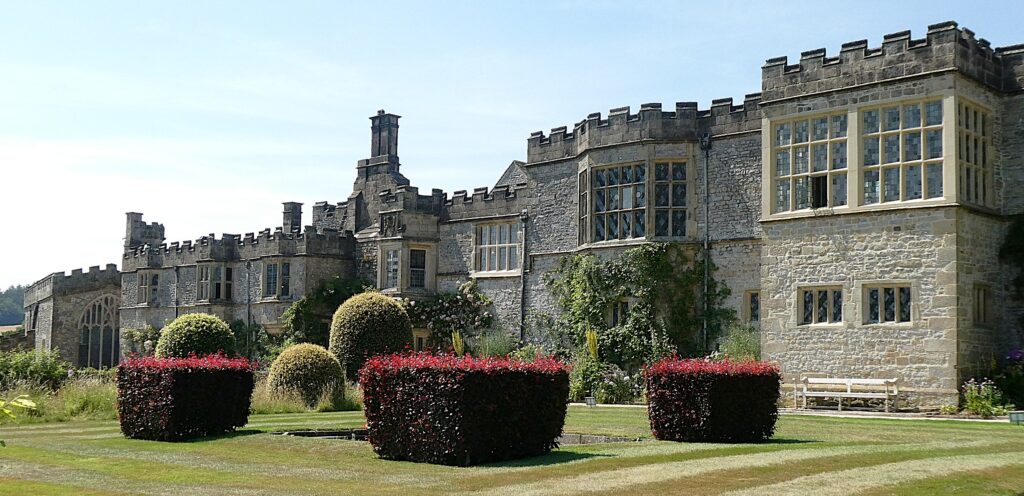
Our walk from the coach park to Haddon Hall soon revealed this grade1 listed house, impressively situated high above the River Wye, seamlessly blending medieval architecture with the beautiful scenery of the Derbyshire Peak District.
A self-guided tour enabled members to step back in time over 900 years of history, paying careful attention to the original stone floors and many steps, which add to the magic and authenticity of Haddon, often called the most perfect house to survive from the Middle Ages. In the absence of the Manners family, who lived at their other home, Belvoir Castle, for 200 years, Haddon escaped any Georgian or Victorian alterations or additions.
Set around two cobbled courtyards, the house contains a banqueting hall, a spectacular 110-foot Long Gallery, remarkable tapestries, and the most important Early English furniture collection in the country,
The cool, dark kitchens also remain as they would have been 600 years ago, with stone bread ovens, chopping blocks and water troughs. Some of our members heard an interesting talk in the C14th chapel of St. Nicholas, with its beautifully preserved frescos.
The rose garden, herbaceous borders, topiary and knot garden are arranged in a series of terraces that cascade down to the river and parkland.
During the visit, members also enjoyed lunch and tea-time treats in the C17th stable block restaurant.
25th June 2026
Acton Round Hall
This car outing was arranged by Michael and Rosie Evers. Acton Round Hall is located off the Bridgnorth-Shrewsbury road, just past the village of Morville. The visit took place on a hot, June day, but the journey was certainly worthwhile.
Acton Round Hall was built for Sir Whitmore Acton in 1713-14. It is a fine noble design in pinkish brickwork with sandstone ashlar. The architect was probably Francis Smith of Warwick. The Hall is located off a winding lane, and makes a warm favourable impression on sight – a handsome, well proportioned building. Today it is the home of the Kennedy family.
The interior is symmetrical with original panelling and interesting rooms, decorative features and furniture. Unusual and surprising contents adorn the house.
Members were taken on guided tours of the house, and were able to explore the pleasant gardens and nearby church. Some of the group attended a demonstration of scagliola work (plasterwork) by the owner, Tom Kennedy.
This was an enjoyable outing to rural Shropshire.
19th May 2026
Tyntesfield
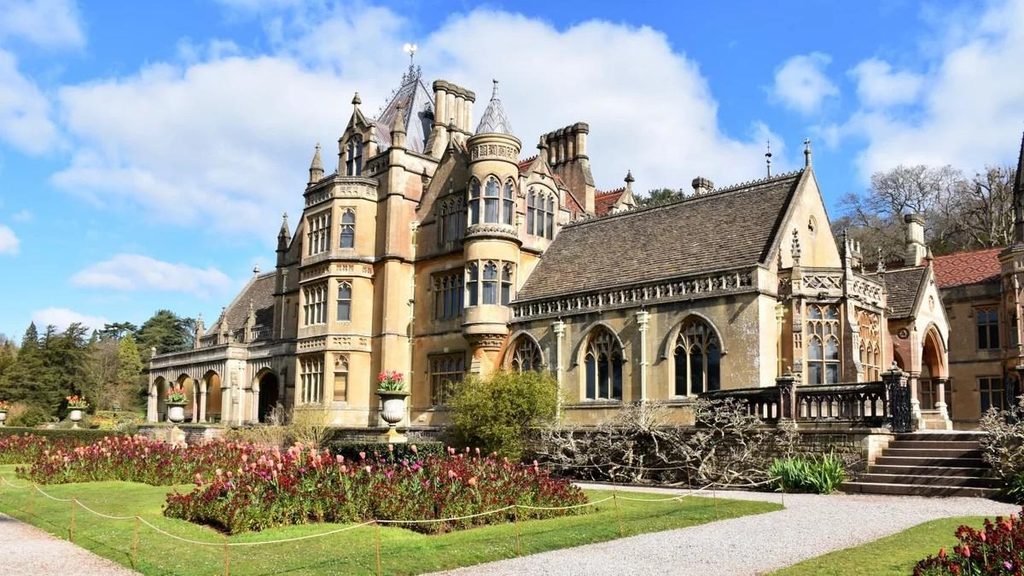
Tyntesfield 19th May
After a smooth journey down the M5 we arrived at Tyntesfield, a Victorian Gothic country house near Wraxhall in North Somerset on a rather showery day. On finding the café was temporarily out of action we were free to immediately explore the house before returning for lunch.
Built as a Georgian mansion in the 1830’s it was English businessman William Gibbs who bought the estate in 1844. An astute merchant he made his vast fortune from Peruvian ‘guano’ or seabird dung – a highly prized fertiliser at that time. It was the profits from ‘guano’ that enabled him to transform an ordinary Georgian house in the 1850’s to the extraordinary Gothic revival masterpiece we see today. We were able to view the many items of incredible art and furniture and some of the 10,000 books on display, one of the largest collections in the NT.
Tyntesfield was owned by the Gibbs family until the death of Richard Gibbs, 2nd Baron of Wraxhall in 2001when the estate was put up for sale.
In 2002 the NT purchased the main central part of the estate comprising 160 acres to include the house, the kitchen garden and the park.
Avoiding the showers many of us were able to explore the extensive gardens before returning to our coach for a rather slow journey home.
Alan Wood
CBSO outing 4th February 2026
On a rare dry February day, a coach party of some 40 members and friends went to Symphony Hall for the first outing of 2026.
Before the CBSO Concert there was the opportunity to attend a performance by the Royal Birmingham Conservatoire Symphony orchestra of four lives by Sir William Walton. This was a treat, and it was a pleasure to listen to these talented and enthusiastic young musicians.
The CBSO Concert opened with a short modern piece, composed in 2020 by CHina Shekhar, entitled “Lumina”. The modest applause it received perhaps indicated lukewarm popularity. In contrast the four last songs by Richard Strauss marketing impression. Soprano Natalya Romaniw gave have a warm and powerful performance which delighted the audience.
For many, the highlight of the concert was Brahm’s 4th Symphony, conducted by Edwardo Strausser. This is a familiar and well loved work, composed in 1885. It is full of rich emotional music, and The CBSO have a spirited performance. It was clear the players enjoyed themselves.
We left Symphony Hall uplifted and refreshed after this stimulating concert.