
11th December 2024
Nursery Rhyme Stories
The speaker at the Centre’s December meeting was Dorothy Nicholl, making a return visit. Dorothy has a big interest in archaeology and history, particularly in her home county of Shropshire. She has been a blue badge guide for some 30years.
The subject of Dorothy’s talk was nursery rhymes, their history and origin. Some are centuries old with several different explanations. For instance, ‘London Bridge is Falling Down’ is said to relate to a Viking invasion and attack on the bridge.
Dorothy referred to a number of familiar nursery rhymes and their links.
Four and Twenty Blackbirds (Dissolution of the monasteries by Henry V111)
Little Jack Horner (The Steward of Glastonbury Abbey)
Little Boy Blue (Cardinal Wolsey)
Little Miss Muffet (Daughter of Doctor Thomas Muffet, who published a book on spiders in 1623)
Jack Spratt (An Arch Deacon)
Grand Old Duke of York (He set up Sandhurst and improved military life and standards)
Bobby Shafto (Ran away to sea to escape marriage)
Banbury Cross (Lady Godiva)
Old Woman who Lived in a Shoe (Symbolism – A shoe is a symbol of fertility)
Bells of St. Clements (Tyburn executions)
Cat and the Fiddle (Caterine of Aragon)
Dorothy agreed many of the links were tenuous and a matter of conjecture. Those present enjoyed her amusing and entertaining talk.
13th November 2024
A History of the Orient Express
The speaker at the November afternoon meeting was Neil Brazier, who has worked in various aspects of the travel industry for over 50 years. He and his wife were partners in an independent travel agency in Stourbridge for well over 30 years.
His talk focused on the history of the Orient Express (the Spy Express), some of its famous passengers, and its revival. It was founded by a member of the Angelmackers banking family in 1899. The original route was from Paris to Sofia in Bulgaria, with a sea transit to Istanbul. Paris to Istanbul covers 3180 km and takes about 76 hours to reach the destination. Celebrities who travelled on the Orient Express included Lawrence of Arabia and Agatha Christie. It was popular for its style and elegance.
James Sherwood of Sea Containers took over the business and tracked down several of the original carriages which have been restored. They are regarded as historic monuments. Routes were extended to Athens and Venice. The current owners are the Belmond Group. They also own the Andean Express and the Singapore-Bangkok Express, amongst others.
Neil Brazier referred to other special rail journeys including the Glacier Express, The Ghan, the Indian Pacific, the Blue Train and the Rocky Mountaineer. The Orient Express remains exclusive and special – and expensive.
8th October 2024
A History of Smethwick
The speaker at the Centre’s October meeting was Mary Bodfish, who founded Smethwick Local History Society in 1984. Since then she has been digging into Smethwick’s past. She began her presentation by showing the location of Smethwick, which is next door to Birmingham. Mary lives by a brook which is the old boundary between Staffordshire and Warwickshire – Thimblemill Brook, which flows into the River Tame.
Smethwick has a long rich history and its origins go back to Anglo-Saxon times. It was an agricultural hamlet, part of Harborne Parish. There was a skirmish there in 1643 in the Civil War. A supporter of the Parliamentary forces was Thomas Parkes, a wealthy ironmonger who built up his iron industry. He died in 1669, and his daughter, Dorothy (1664-1728), inherited his fortune. On her death 12 trustees administered her estate, and Smethwick Old Church was built. It was consecrated in 1732, and there is a memorial to Dorothy in the church.
Mary referred to some well known Smethwick landmarks – Holy Trinity Church (built in 1837), the Toll House (1820) in the High Street, The Blue Gates public house (rebuilt in 1932) and the Red Lion (which was rebuilt in 1936). The Mitchells and Butlers Brewery started at Cape Hill in 1878 – the large site is now a housing estate.
The construction of Brindley’s canal marked the growth of industry in Smethwick, a move away from agriculture. The canal linked Birmingham and the Black Country. The bridge over the canal at Galton Bridge dates from 1828 and is Smethwick’s only grade 1 listed building. Foundries, glassworks and forges developed, such as Matt, Boulton and Murdoch’s Soho Foundry. W & T Avery’s weighing machine factory and Chances Glassworks.
Chances Glassworks made the glass for the Chatsworth’s conservatory and for the Great Exhibition (1851). They specialised in optics and fittings for lighthouses. The Concorde aircraft windows were made in Smethwick.
Other well known Smethwick companies included Guest, Keen & Nettlefolds, the Birmingham Railway Carriage Company, Tangyes (Hydraulic presses and jacks), Samuel Evans (stained glass), and T. Mason & Sons Ltd (orangeade). Smethwick had many skilled workers.
Mary referred to Lightwoods House, which dates from 1790, a grade 2 listed building. Sandwell Council acquired it from Birmingham City Council in 2010. It has been extensively restored. The parkland at Warley Woods was designed by Humphrey Repton. Warley Abbey was built in 1820, but sadly this impressive building was demolished in 1957.
Smethwick has some notable civic buildings including the Public Library, The Council House, and the Art Deco Thimblemill Public Baths (1933)
Smethwick became a Borough in 1899, and then a County Borough. The motto on the coat of arms was “Work & Genius”. Smethwick played a prominent part in producing armaments in World War11 – and Scrivens, the bakers, produced cakes and biscuits for the forces. Smethwick was bombed during the war (10 air raids 1940-1942, with extensive damage.
Post war there were sweeping changes with the loss of many landmarks. New housing developments took place. In 1966 Smethwick was “moved” from Staffordshire into Warley, and the in 1974 became part of the Borough of Sandwell. Smethwick is now the the home of the largest Sikh temple outside India. It is the birthplace of Actress Julie Walters.
Mary Bodfish is clearly proud of her home town, and her enjoyable talk was well received by her attentive audience
10th September 2024
From Belbroughton to Botany Bay (Sarah Bellamy)
The new series of indoor meetings began with David Cox’s presentation about Sarah Bellamy of Belbroughton. Dr. Cox is Reader of Criminal Justice History at the University of Wolverhampton.
Dr. Cox focused on Sarah Bellamy, who was baptised at Belbroughton on 3rd February 1770. The Bellamy family were in receipt of poor relief for most of the time. Sarah went to work in Dudley, where she stole 15 guineas from Benjamin Haden. She was sentenced at Worcester Assizes to be transported for 7 years. This form of punishment had begun in 1615. Sarah was jailed in a prison hulk on the Thames awaiting transportation to Australia.
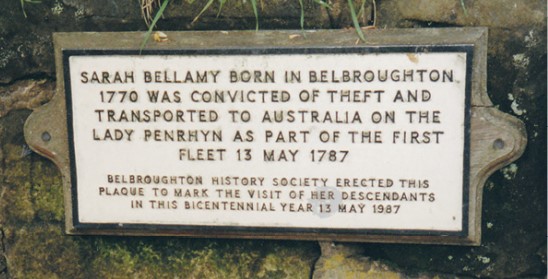
Above Plaque in Belbroughton
Captain James Cook had established colonies in Australia. Convicts were subsequently transported to New South Wales, then Tasmania and ten Western Australia. Convicts were originally transported to the USA, but this stopped with the American War of Independence. Sarah Bellamy was one of the first convicts to be transported to Australia. She sailed on 13th May 1787 on the 7-month voyage. There is no recorded image of Sarah, but it is known she was red haired. In 1789 she was charged with a breach of the peace but was found not guilty.
Sarah met James Bloodworth, who had also been transported, and became his common law wife. James was originally from Kingston-on-Thames, and was a bricklayer, a skilled worker, who designed and built the Governor’s house. He was well regarded and was later granted a free pardon. He had 7 children with Sarah. He died in March 1804, aged 45, from pneumonia, and was granted an official funeral.
Sarah, who remained illiterate throughout her life, face financial problems on James’s death. She died in Sydney on 24th February 1843. Two direct descendants of Sarah have visited Belbroughton, and links remain with Botany Bay.
Transportation to Australia continued until 1868. Dr. Cox has visited Australia on a number of occasions – an enjoyable and recommended destination.
14th May 2024
Wonders of the Silk Routes
The speaker at the Centre’s May meeting was Dr. Javad Hashemi. He was born in Teheran. He taught Biology and Science Education at the University of Teheran, before coming to the England and working in education. He enjoys photography, has an interest in butterflies, and collects egg cups.
Silk Routes originally started from China and have a long history. They became a network of trade routes, helping to transfer goods and ideas from East to West. There was a big production of high-quality silk robes in the Han Empire in China which were exported to the West. Trade grew, and tea, jade and spices were also exported. Bactrian camels were used to transport the goods. Samarkand became a major trade hub, and trade extended to the Mediterranean and Venice, a distribution centre. The caravans received protection as they travelled through the different regions, including the Mongol Empire and the Turkish Empire.
The Silk Routes brought prosperity and merchants became wealthy. Now, modern China is reviving those old trade routes, building new roads and railways in developing countries around the World. China’s influence is growing as a result.
Dr. Hashemi’s talk focussed on an aspect of history not widely known.
9th April 2024
Athelflaed: England’s Forgotten Queen
The speaker at the Centre’s April meeting was Chris Green, making a welcome return visit. Chris developed a love of history at school. After university he worked in industry, but returned to his passion, writing, researching and making presentations on history, often relating to lesser known aspects.
Athelflaed was the daughter of Alfred the Great. She was the wife of the Lord of Mercia. Her brother Edward carried on the work of their father, Alfred, and they worked together to push back the invading Danes (Vikings). Athelflaed was prominent in some notable victories over the Danes. At that time there were seven kingdoms in England with Offa leading Mercia.
The Danes plundered Christian communities and monasteries, and caused problems in England for about 60 years. In 865, 10,000 Danes invaded Kent and headed for East Anglia. There, King Edmund paid them to go away and provided them with horses. The Danes then roamed England, subsequently returned to East Anglia and killed King Edmund in battle. Danish rule was extensive with only Wessex not under their influence. There was a further invasion in 902 when Danes came from Dublin, down the River Mersey, into Cheshire. Mercia cavalry were dispatched from Tamworth, Mercia’s capital, to face the invaders as they approached Chester. The Mercians went into the Danes’ territory and were victorious. Later Danes sailed up the Severn to Bridgnorth, and went into battle with the Mercians on the outskirts of Wolverhampton, but failed again. Athelflaed’s leadership in these engagements was significant.
In August 910 Athelflaed was elected Lady of Mercia – Effectively Queen. Her brother, Edward, was not happy with the Witan’s (Parliament’s) decision. There were no further Danish attacks. Athelflaed fortified several towns including Worcester, Hereford, Shrewsbury, Bridgnorth and Eddisbury. She led he victorious troops into Derby and Leicester, and York was left as the only Danish-ruled area in England.
Athelflaed died in June 918 at the age of 48.She was buried in Gloucester, alongside her husband. She was a formidable leader and warrior.
12th March 2024
Kilimanjaro: Dare to Dream
The speaker at the Centre’s March meeting was Alan Peace. He has been climbing since the age of 15 and it was always his ambition to climb Kilimanjaro. He ultimately realised this personal dream.
Kilimanjaro is about 19500 feet high and is the highest dormant volcano in the world. Located in Tanzania it is Africa’s highest point. It takes about 4 or 5 days to climb to the top, and 2 days to descend. About 17000 people try ty climb Kilimanjaro each year,
Alan refereed to the perils of high-altitude sickness which can prove fatal. He described his ascent of Kilimanjaro and his trek to the summit. His adventure was illustrated by images taken by himself. Alan gives talks to support the work of Cancer UK, and he has raised substantial sums for the charity.
At the age of 78, Alan’s love of climbing remains. His current ambition is to climb the highest peak in Alaska. In the meantime, his next project is to walk the Offa’s Dyke path and the Welsh Coastal path together.
13th February 2024
Annual General Meeting
The meeting was chaired by David Brown, President. He extended a walm welcome to everyone present. It was pleasing to see a good attendance. David thanked the Officers and Committee for their hard work during the year.
The Chairman, Chris Fonteyn, presented his 34th annual report. The year under review had been a period of consolidation. He referred to the programme of outings, meetings during the year and the holiday in the Scottish Borders. There was a lower level of support for the coach outings and two planned trips had to be cancelled. He acknowledged the time and effort given by the committee in support of the Centre. He referred to our fundraising efforts during the year, and a stable membership. The Centre was inaugurated on 3rd April 1984, and he outlined events planned to mark the coming 40th anniversary. He felt it was time for a successor to take his place as Chairman, and he stressed the urgent need for new committee members to come forward. Members must get involved in helping to run our Centre.
The Treasurer, Trevor Sidaway, presented the audited accounts. The Centre’s finances are sound and satisfactory, and a modest surplus resulted after making donations totalling £2000.00 to four NT properties. A proposal to increase annual membership fees to £10 single and £15 family, with effect from 1st April 2024 was approved.
The election of the officers and committee members took place. After 30 years on the committee, Sheelah Bolam, had decided to stand down. Her energy and enthusiasm will be greatly missed. She was elected a Vice-President of the Centre in recognition of her outstanding contribution to the success and development of our Centre. A presentation was made to her. Linda Button was welcomed as a new committee member.
Long service awards were presented to six officers and committee members. The results of a members’ survey regarding outings were disclosed. An outline of the plans for outings and a holiday in 2024 were presented.
After the business meeting, a presentation was given by NT staff from Dudmaston, Gow Gibson (Operations Manager) and Laura Bishop (Senior House and Collections Manager). Dudmaston is a special place, and it is a pleasure to work there. It is a working estate of 3000 acres, given to the NT in 1978. Descendants of the donor family still live there, and the family has been on the site since 1127. Lady Labouchere, a descendant of Abraham Darby of Ironbridge, and her husband, a retired diplomat, took on the estate in 1966, before transferring it to the NT. Dudmaston is the home of an important and extensive art collection. Lady Labouchere was herself an artist and a collector of fans. Members of the audience were taken on a virtual tour of the property. The Centre has given a donation of £500 for the restoration of a Coulport Porcelain Basket in the ceramics collection.
Michael Evers gave a vote of thanks at the conclusion of the meeting.
17th January 2024
Canal Heritage – A Cruise Around the West Midlands
Roger Butler was the speaker at the Centre’s first meeting of the new year. He is a writer and photographer with a keen interest in canal and industrial heritage. He has worked on a number of canal restoration projects.
The canal network grew as industrial development moved forward, but contracted as the railway network expanded. Horse drawn barges took 3 days to travel between London and Birmingham, and could not compete with the speed of trains. Today the national canal network is about 2100 miles in extent, centred on the Black Country and Birmingham like a spider’s web. Canals now are now largely used for recreation and holidays.
A number of well known firms used the canals to move goods to and from their factories and warehouses, such as TyphooTea, Geest Bananas, and Cadbury’s Chocolate (barges brought in milk for the Bournville factory). Pickfords started their business in London with 2 boats.
Impressive feats of engineering are associated with the canals – Stourport on Severn developed as a hub and many tunnels and bridges were constructed. It was a hard life working on the canals particularly when flights of locks had to be negotiated. Ice breakers were often needed in the winter, and in the great freeze of 1963 many boats were trapped in the ice. Most canal barges were brightly painted and decorated, and these skills continue.
When the canal era came to an end, there were campaigns to save and restore the heritage. The work of volunteers was so important and restoration projects such as the Dudley Tunnel and the Stratford canal were successful. Unique architectural features of buildings alongside canals had been saved.
The second half of Roger’s talk was devoted to a cruise around the West Midlands on the local canals, during a fortnight in July 1971. This was undertaken by a married couple who recorded their holiday experience in words and photographs passed on to Roger, who shared them with his audience. It was interesting to see how run down canal scenes have been transformed into what we see today, especially in Birmingham City centre.