
Houghton Tower & Samlesbury Hall, 25th April 2018

The visit to Lancashire began with one of the finest medieval houses in the county. Samlesbury Hall was acquired by the Southworth family by marriage in 1325 and members of the family fought in campaigns in both France and Scotland where they were frequently knighted. The oldest part of the present house is the magnificent great hall dating from the early fifteenth century with its interior open to the massive timber roof, and it was in this impressive room that the buffet lunch was laid out. The south range as added in the early sixteenth century and was originally all in timber, but the south side was faced in brick in 1545.
The Hoghton family trace their descent back to the time of William the Conqueror and they have owned the Hoghton Tower estate since the beginning of the thirteenth century. In the Elizabethan era Thomas Hoghton built the present house round two courtyards. The family received a baronetcy in the early seventeenth century and James I visited Sir Richard in 1617. He stayed here with a retinue of 300 soldiers for three days. In the large banqueting hall he is reputed to have knighted a loin of beef, thus inventing “sirloin”. The table on which the investiture took place is still preserved in this room.
Eric Greenwood
Sandon Hall, 9th May 2018

On 9 May, on our way to Sandon Hall, we visited the Museum of Cannock Chase. A fascinating little museum, housed in the old lamp room of a Cannock area colliery, on the edge of Cannock Chase and the Hednesford Hills heathland. As well as a brief history of the Chase and extensive collection of mainly cardboard games from Victorian times on it has an extensive display of coal mining memorabilia, including a mock-up of a lift cage, complete with creaks, whines, shakes and rattles. After a ‘canteen lunch’ we travelled on to Sandon Hall, approached by a mile-long drive through rolling parkland. The Hall has been in the Harrowby family since 1776. Following an extensive fire in 1848 the house was rebuilt in sandstone ashlar in the new-Jacobean style by architect William Burn. The family have had considerable involvement in both political and military life and, since the 2nd Earl’s marriage to Lady Frances Stuart, grand-daughter of founder of Coutts Bank, banking. In recent years the family has been based in the Cotswolds, leasing the house to succession of tenants who reduced garden maintenance gradually until just that which can be seen from the house. Recently the present Earl’s son has taken a greater interest in the house and while we were there the gardening team were frantically trying to recreate a rose walk, temple and other delights in preparation for his coming wedding.
Katey Fletcher
Tatton Park, 23rd May 2018

On Wednesday 23 May we set off, breaking our journey at Stafford Services. On arrival at Tatton, we enjoyed a tasty two-course meal in the Stables Restaurant, after which we were free to explore the grand country estate, and enjoy the magnificent, colourful gardens, including the 100-year-old Japanese garden and the walled kitchen garden; and to see the Egerton family’s impressive collection of fine art, books and furniture in the mansion. Some of our members also indulged in tea at the Gardeners’ Cottage before we started on our homeward journey. A good day was enjoyed by all.
Marjorie Fernihough
Hellens, 21st June 2018
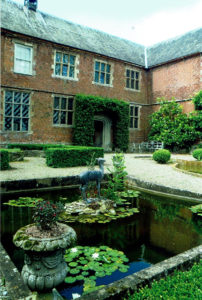
The 21 June was a fine day when over sixty of us visited Hellens at Much Markle. Hellens is probably one of the oldest houses in the country with its history dating from the eleventh century.
Before embarking on a tour of the house we enjoyed coffee and biscuits in the barn which has been converted into a pleasant dining area. Having been refreshed we were introduced to our guides for the tour. As one would expect the age and changes over the past 900 years were reflected in the different parts of the house and we were shown around during a comprehensive and informative visit to a wide variety of rooms and other parts of the house. Of particular note was Hetty’s room where a daughter of the family eloped in the late 17th century with a local lad, then having been abandoned, returned home and was confined to this one room for the remaining thirty years of her life. When the tour was over we reassembled in the barn for a very wholesome and filling lunch after which there was time for a wander round the gardens and grounds.
Ledbury is only a few miles from Hellens and a lengthy stop was made there during the journey back to take in its varying interests and satisfy the usual members’ requirements for afternoon refreshments.
Eric & Denise Carson
Winterbourne House & Barber Institute, 12th July 2018

On 12 July we visited The Barber Institute, part of Birmingham University. After an introductory talk we had guided tours of the collection. Our guide used selected paintings to illustrate: Who Chooses the Artwork’s Theme/Subject? During mediaeval and early Tudor times artists needed a patron. Equipment was expensive, the sourcing and grinding of paint ingredients time-consuming and the resulting paint dried so quickly that left overs represented wasted money and effort as it could not be stored. The growth of the middle classes in later Tudor times brought more opportunities. Still later, the general reduction of costs and commercial manufacture of paint with a shelf life, enabled artists to be free to choose a subject and how they presented it. Seems so obvious but I must confess I for one had not really thought it through. Winterborne House, also part of the University, is a late Victorian house, built for the Nettlefold family (GKN fame) with seven acres of gardens. On the day of our visit it was in the middle of the summer heatwave but still the flower beds were filled with colour and humming insects. A lovely place and amazing that it has survived so close to the city centre. The café’s tea and cakes were also lovely.
Katey Fletcher
Kinnersley Castle, 15th August 2018
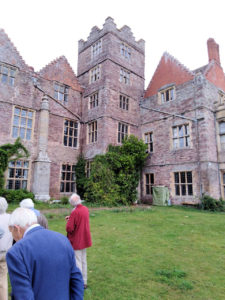
On Wednesday 15 August a limited number of members met at Kinnersley Castle, now owned by the Garatt-Adams family – a Grade II listed building originally built by the Normans as a castle guarding the Welsh marches. It was remodelled in Elizabethan times for the Vaughan family, and over the years many additions made. It was purchased in 1954 by Henry Garratt-Adams whose family still maintain the house. We were met by members of the family and had a buffet lunch in the dining room. We were then split into two groups, one group viewing the garden and the local church next to the castle which contains many interesting monuments to the families that have occupied Kinnersley over the centuries.
The other group was taken round by Mrs Katherina Garratt-Adams whose exceptional knowledge about the house and the families who have lived there over the centuries was very interesting, also the work that has been done to restore the house and still continues. Our tour of the castle being quite extensive right to the top floor of the tower to what is now a bedroom but was originally part of the long gallery which encompassed the whole of this floor and would have been part of the original Elizabethan house. In the solar there is a fine plasterwork ceiling, and many of the rooms still have retained their wooden panelling. After about 45 minutes the two groups swapped over, and we then met up for a cup of tea or coffee before making our journey homewards.
A very interesting and enlightening visit as we learnt about the history of the castle and what it takes to keep it going, which is a credit to the family.
Vic Powell
Wilton House, 21st August 2018

After a slightly unpromising start to 21 August, the sun broke through and produced a bright warm day for our outing to Wilton House, near Salisbury. We had an “eventful” coffee stop at Wyevale Garden Centre, Swindon. Evidence if needed that the best laid plans can go astray!
The journey to Wilton is long but quite picturesque, including a marvellous view of Stonehenge. On our arrival to the House we were very warmly greeted by the Visit Co-ordinator and given comprehensive information about the delights that awaited us, including an excellent buffet lunch.
Although not an advertised attraction it was a pleasant sight to see children enjoying paddling in the lovely clear stream in the grounds and beautiful dragon flies darting around the ponds.
The Earl of Pembroke’s state rooms are most impressive as too are the 19th century cloisters which contain magnificent statues of some considerable age.
Eric & Denise Carson
Hatton Grange, 5th September 2018

On a glorious, sunny day we travelled to the Shropshire property, Hatton Grange, near Shifnal. It is the well-loved family home of Rupert and Christina Kenyon-Slaney. We received a warm welcome on our arrival, and Mr Kenyon-Slaney gave us a lively introductory talk, outlining the history of the house and his family.
Hatton Grange was built in 1764 for Plowden Slaney by the Shrewsbury architect Thomas Farnolls Pritchard, designer of the iron bridge in Coalbrookdale. Hatton Grange is a fine provincial Georgian country house in red brick, “improved by the Victorians”, in Mr Kenyon-Slaney’s view. The family became wealthy, supplying coal to Abraham Darby’s ironworks. Col. William Kenyon-Slaney, MP, scored the first international goal for England at football, against Scotland in 1873.
Mr and Mrs Kenyon-Slaney took us on guided tours of the house and gardens. The house is tastefully decorated with delicate plasterwork and furniture made by Lord Linley, son of Princess Margaret. It is an attractive property, set in beautiful countryside. After an enjoyable lunch, we headed for Wightwick Manor on the outskirts of Wolverhampton.
Wightwick Manor was acquired by the Trust in 1937. It dates from 1887 and was the home of the Mander family. It is filled with works of art from the Pre-Raphaelite and Arts and Crafts movements. The Victorian manor is a contrast with the Georgian elegance of Hatton Grange.
Chris Fonteyn